

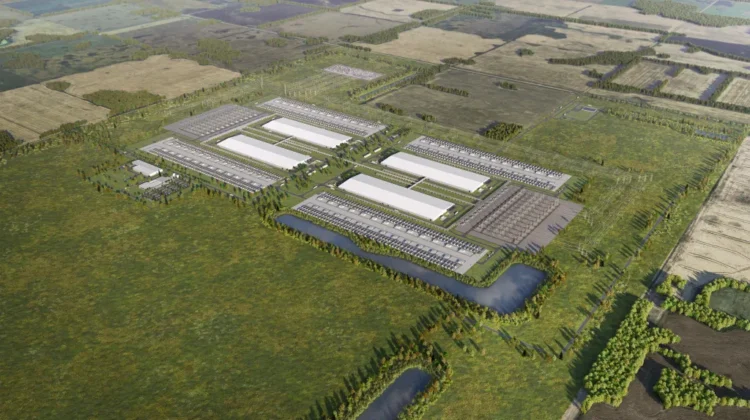
Meta has officially unveiled its first Canadian data centre: a $13 billion-plus development in Sturgeon County, Alberta.
The Meta Sturgeon Data Centre will support the global infrastructure behind Meta’s technologies and programs, serving a user base the company says now exceeds 3.5 billion people worldwide.
The Alberta project is one of the largest data centre investments announced in Canada to date and marks a major new entry in the country’s hyperscale infrastructure market.
Meta expects approximately 3,000 skilled trade workers to be onsite at peak construction. Once completed, the facility is expected to support roughly 300 operational jobs, including electricians, HVAC specialists, server and network technicians, and engineers.
But the most important part of the project may be what sits behind it: dedicated power.
Pembina Pipeline, Morgan Stanley Infrastructure Partners, and Kineticor Asset Management are partners in the Greenlight Electricity Centre Limited Partnership, which will provide behind-the-meter power for Meta’s data centre. Pembina says the project reflects growing demand for reliable, large-scale electricity to support AI and cloud infrastructure.
Greenlight is a 932-megawatt gas-fired combined-cycle power-generation facility planned for Sturgeon County, within Alberta’s Industrial Heartland. Pembina says the facility will serve the data centre under a long-term tolling agreement and is expected to enter service in the second half of 2030.
The scale of the power project is substantial. Pembina says Greenlight has an estimated total project cost of approximately $4.6 billion, including financing costs, and that the site has potential expansion capacity up to 1,864 megawatts. The project is also expected to require approximately 150 million cubic feet per day of natural gas.
For the data centre sector, the commercial structure is notable. Greenlight and the customer have entered into a long-term Electrical Energy Supply Agreement under which Greenlight will provide 932 megawatts of capacity to power the data centre. Pembina describes the agreement as a tolling arrangement supported by capacity payments and usage-based payments, including fuel and operations and maintenance costs.
The project fits Alberta’s “bring your own power” approach to large AI data centres. Sturgeon County says the Meta campus will combine grid-connected electricity with new on-site natural-gas generation, while Alberta requires large data centres to pay for the infrastructure needed to support their operations.
Meta says it has been working with Greenlight Limited Partnership, Altalink, Capital Power, and the Alberta Electric System Operator to plan for its energy needs years in advance. The company says it will pay the full cost of the energy used by the data centre so consumers are not negatively impacted.
The Sturgeon project also places water efficiency at the centre of its design.
Meta says the data centre will use a closed-loop system that circulates a water mixture through data halls to absorb and transfer heat generated by high-density computing hardware. Heat will then be removed from the system using dry cooling, which Meta says requires no operational water use.
As a result, water needs are expected to be limited to construction activities, facilities use, and fire sprinkler systems. Meta says the site will also use native vegetation where possible, capture and infiltrate rainwater onsite, and incorporate water-saving fixtures and technologies.
The company is pairing those measures with a local watershed initiative. Meta says it is partnering with ALUS to support farmers in conserving 200 acres of grasslands, trees, and wetlands in the North Saskatchewan River watershed.
The Alberta project arrives as AI-driven demand reshapes the economics of data centre development. Hyperscale projects increasingly depend not only on land and fibre, but on access to large amounts of reliable power, credible water strategies, and long-term local infrastructure planning.
For Canada’s data centre sector, Meta’s Sturgeon Data Centre is a landmark project.
For Alberta, it is evidence that the province’s gas-to-power strategy can compete for the next generation of AI infrastructure.