

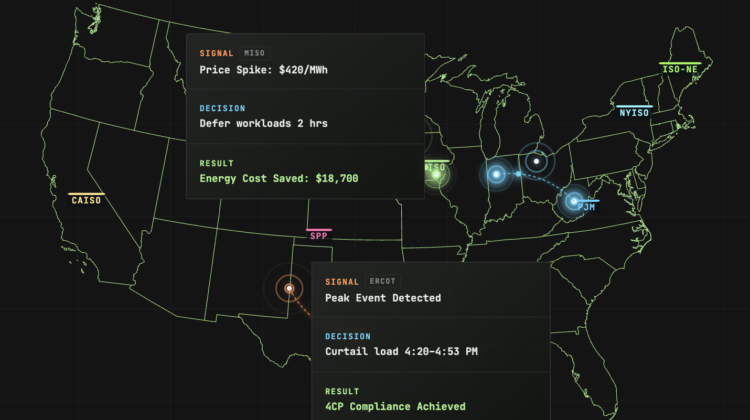
The AI infrastructure boom is colliding with a stubborn physical constraint: electricity. While data centre developers are searching for enough power to support the next wave of computing, Vancouver-based LōD Technologies is approaching the challenge from another direction—by making the compute itself responsive to the grid.
LōD connects electricity-grid and market signals with data centre power systems, GPU clusters, and cloud-routing infrastructure. Its technology determines within milliseconds whether an AI inference request can be served from another location or supported by a different energy source without compromising latency, accuracy, reliability, or service-level agreements.
That flexibility could become increasingly consequential as inference—the process of using a trained AI model to answer real-time requests—accounts for a growing share of AI computing. Rather than treating these workloads as permanently tied to one location, LōD believes they can become a flexible resource that helps operators manage power constraints and bring new computing capacity online faster.
The company will test that proposition through the Dominion Energy Innovation Center’s 2026 Accelerate program. Working with Dominion Energy in Northern Virginia, the world’s largest data centre market, LōD will pilot an automated system that coordinates AI workload routing with power infrastructure and GPU-cluster orchestration.
DataCentre.ca spoke with LōD founder and CEO Medi Naseri about the Dominion pilot, the technical challenge of shifting inference workloads in real time, and how compute flexibility could reshape utility planning and the path to power for AI infrastructure.
What problem did LōD set out to solve, and why have AI inference workloads historically been treated as inflexible electricity demand?
MN: We set out to address the mismatch between how quickly AI compute demand is growing and how quickly the power system can expand. New generation, transmission and distribution infrastructure can take years to build. The most acute problem appears during grid peaks, when generation and network capacity are under the greatest pressure.
AI demand can also be unpredictable, with rapid power swings affecting grid stability. But inference has been treated as inflexible because users expect an immediate answer. Unlike many training jobs, most requests cannot be paused and completed hours later.
That does not mean the workload has to run in one fixed location. Deloitte expects inference to account for roughly two-thirds of AI compute in 2026. LōD’s planning scenario puts that share at about 80% by 2030. If we want flexibility to matter at the scale of AI’s power demand, inference has to be part of the solution.
How does your technology determine when and where an inference workload can shift without affecting response times, accuracy, or service-level agreements?
MN: Because inference is time-sensitive, the options differ from those for a deferrable training job. You may change the power source behind the meter, reduce local demand where the workload permits it, or serve the request from another location.
LōD coordinates those choices through two layers. An energy strategy layer evaluates grid conditions, energy availability, price and emissions against operator preferences. An execution layer determines whether infrastructure can be throttled or paused, switched to backup power, or the workload routed elsewhere.
The difficult part is making that decision within milliseconds. Latency, model performance, reliability, data requirements and the customer’s SLA are constraints, not variables we trade away. The system acts only when an eligible alternative can meet them. We have spent five years developing that capability across the power, compute and cloud layers.
Lower energy cost and emissions are natural results from the technology we’re building. But the largest value may be Speed to Power: bringing more compute capacity online sooner instead of waiting years for conventional grid expansion.
What will the Dominion Energy pilot involve, and what results will you need to see to consider it successful?
MN: Dominion Energy serves Northern Virginia, the world’s largest data center market, placing it at the center of AI’s capacity and reliability challenge.
The pilot will demonstrate an automated, end-to-end decision process across different AI workload profiles. A key focus is coordinating LōD’s inference routing with power infrastructure and GPU-cluster orchestration. Flexibility cannot sit in only one layer: the power system can change the energy source, the data center can change equipment demand, and the cloud layer can move the workload.
Success means showing that those layers can respond together, produce a measurable change in electricity demand, and avoid a material impact on response time, accuracy, reliability or SLAs. The response must also be automated, auditable and repeatable.
What technical or operational changes would a data centre operator need to make to participate, and can LōD work with existing infrastructure and orchestration platforms?
MN: Our goal is to make the starting point very light. An inference cluster can connect to LōD’s energy-aware routing layer in under 10 minutes, without replacing infrastructure or exposing confidential user data. The operator defines the performance, policy and operating constraints that routing must respect.
The integration can then deepen. Some customers may begin with distributed workload routing; others may connect GPU controls, backup generation, batteries or other power infrastructure. Operators should not have to redesign their stack before they can become flexible.
If AI inference becomes a reliable flexibility resource, how could that change utility planning, data centre interconnection timelines, or access to constrained power markets?
MN: It could shift the conversation from a binary decision – whether the grid can serve a large firm load – to a defined operating agreement. If a data center can cap grid withdrawal or reduce demand under specified conditions, a utility may be able to connect it sooner and plan around an enforceable load profile.
This direction is already visible. ERCOT has approved its Batch Zero process for large-load interconnections, with related requirements under PGRR145 and NPRR1325. PJM has outlined pathways that include bringing new generation and a “connect and manage” model subject to earlier curtailment. Similar initiatives are taking place with California’s PG&E, Portland’s PGE, Pennsylvania’s Exelon, Virginia’s Dominion Energy.
The unanswered question is execution. An agreement does not by itself make a data center flexible. The operator still needs to know which layer should act, how quickly, and how to protect customer service. LōD’s role is to turn those conditions into coordinated execution on flexibility across energy and compute infrastructure.
Beyond this pilot, what is the commercialization path for LōD, and how quickly could the technology scale across PJM and other electricity markets?
MN: The technology is commercially ready and operating in production environments. CLōD.io is one proof point: more than 7,000 users are actively routing inference workloads through the platform. We are also in discussions with major infrastructure manufacturers and neocloud providers.
The commercialization path includes direct deployment with data center and cloud operators, integration with infrastructure providers, and collaboration with utilities. The software-based routing architecture can scale across markets quickly; what changes are the grid signals, rules and operating requirements.
Deeper coordination with electrical systems and GPU controls will be site-specific. But operators can begin with energy-aware routing, demonstrate flexibility, and expand the controllable assets over time. That is how compute flexibility moves from pilot programs into a standard operating capability.