

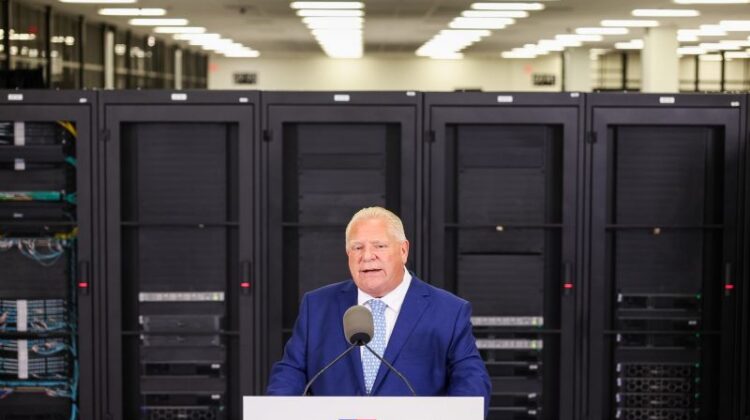
Ontario says large new data centres should pay more for electricity and prove that they will benefit their host communities before they are allowed to connect to the provincial grid.
The plan is set out in a draft Data Centre Playbook released this week. It is Ontario’s proposed rulebook for deciding which projects get access to limited grid capacity as demand for AI and cloud computing grows.
The biggest change would be a separate electricity billing category for large new data centres. Ontario is considering applying it to facilities larger than one megawatt, but that threshold has not been finalized.
The change concerns a part of Ontario electricity bills called the Global Adjustment. That charge helps pay for power-generation contracts, regulated generating stations and conservation programs.
Large industrial customers can currently reduce this part of their bill through the Industrial Conservation Initiative by cutting their electricity use during the five highest-demand hours of the year. New data centres in the proposed category would not be allowed to use that program. In practical terms, they would lose a tool that can significantly lower electricity costs.
Existing data centres would stay under the current billing system. The province has not yet decided exactly how the new rate would be calculated or whether some facilities should be exempt.
The size of the development pipeline helps explain the concern. Ontario says proposed data centres seeking grid connections could require more than 10,000 megawatts in total. That is equal to about 40 per cent of the province’s recent peak electricity demand of roughly 25,000 MW. By comparison, data centres now participating in the industrial program account for an estimated 100 to 200 MW.
The higher power rate is only one part of the plan. Ontario also wants a direct say in which large data centres may connect to the grid.
A 2025 change to the Electricity Act allows the government to set conditions for connecting data centres and other very large power users. Once the detailed regulations are in place, a covered project that fails to meet those conditions could be refused a connection.
The playbook would put each project through two reviews. The first would ask whether the grid can reliably serve it and who will pay for any new power lines, generating capacity or other upgrades. It would also consider whether the developer plans to build some of its own power supply.
The second review would ask what Ontario and the host community receive in return. The province has identified three priorities: economic benefits, Canadian control of important data, and meaningful local investment.
That means developers would be expected to show how many good jobs they will create, how much they will invest and whether they will use local workers and suppliers. Projects could also be judged on the tax revenue they produce, the training and apprenticeship opportunities they offer, and any infrastructure they provide to the community.
Ontario would favour projects that keep sensitive Canadian data in Canada, support cybersecurity and, where possible, are Canadian-owned and operated.
Environmental and municipal impacts would matter as well. Developers would have to address noise, water use and pressure on local utilities. The province says it will prioritize closed-loop cooling, which recirculates coolant and can use virtually no water during normal operation.
The government says developers should pay for the grid upgrades their projects require and is encouraging them to bring their own power generation. It also says it will offer no direct financial support. Help would instead be limited to measures such as guiding projects through the permitting process.
Premier Doug Ford said new projects will have to “pay more for electricity so no energy costs are passed on to hardworking families.”
For now, these are proposals rather than final rules. The public consultation closes at 11:59 p.m. on September 12. Ontario says it will consider the feedback before releasing a final playbook as part of a broader AI industrial strategy expected this fall.