

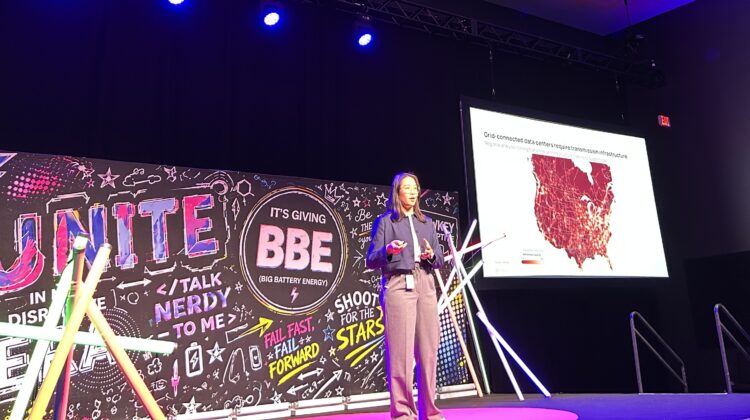
Artificial intelligence may be driving unprecedented demand for new data centres, but the power systems needed to support them are becoming one of the industry’s biggest constraints.
That was the message from Daphne Deng, Vice-President, Analytics at Orennia, during Energy Disruptors: UNITE 2026 in Calgary, where nearly 3,000 industry leaders gathered to examine the collision of energy, artificial intelligence, infrastructure and geopolitics.
Deng told delegates that data centre development across Canada and the United States continues to accelerate, but limited transmission infrastructure is threatening the viability of many proposed projects.
Grid Connections Hit a Wall
Nearly 80 per cent of data centres currently in development are seeking to connect directly to the power grid, she said. The problem is that many of those projects are being proposed in regions where transmission systems are already constrained.
Orennia’s analysis suggests limited infrastructure could prevent nearly half of announced data centre projects from ultimately reaching commercial operation.
The analysis comes as Calgary-based Orennia continues to expand its energy-market intelligence business. The company raised Series C growth financing in January 2025 in a round led by Decarbonization Partners, a joint venture between BlackRock and Temasek.
Orennia’s AI-powered Ion_AI platform provides data and analytics across power, renewables, clean fuels and carbon capture, with the company identifying data centres as one of the markets where it planned to expand its capabilities.
That pressure is already changing how developers think about power.
Developers Look Beyond the Grid
One increasingly common approach is behind-the-meter generation, where data centres generate electricity onsite rather than relying entirely on the grid. Deng said just over 10 per cent of announced capacity pursued that strategy in 2025, compared with nearly one-quarter in 2026.
Natural gas is currently the most common fuel source for those projects, although the viability of the strategy depends heavily on access to sufficient gas infrastructure and competitive pricing.
Developers are also exploring flexible interconnection models that combine grid power with onsite generation or battery storage.
Under highly constrained conditions, Deng said only roughly 20 to 30 per cent of the transmission grid can accommodate a 100-megawatt data centre without additional upgrades. Using flexible approaches that allow onsite generation to cover periods of peak grid stress could increase that potential to roughly 40 to 50 per cent.
2027: Speed and Flexibility
Despite those challenges, Orennia does not expect the data centre boom to slow.
The firm forecasts operating data centre capacity across Canada and the United States will be roughly four times today’s level by 2030. By 2028, Deng said that capacity could represent electricity demand equivalent to Japan, and by the end of 2030 could reach the equivalent load of India.
After 2025’s AI boom and a 2026 marked by power constraints, new tariffs, community opposition and regulatory intervention, Deng expects the next phase of development to focus increasingly on speed and innovation.
Her message for 2027 was clear: developers and investors able to combine infrastructure analytics with more flexible approaches to power will be best positioned to turn AI-driven demand into data centres that actually get built.