

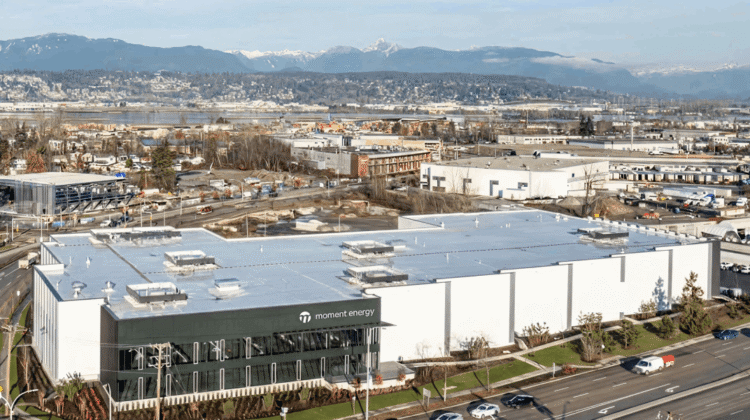
Moment Energy is building what it says will become the world’s largest battery repurposing facility in Surrey, B.C., a project aimed in part at meeting growing energy demand from data centres and other power-intensive industries.
The Vancouver-founded company announced that the facility will be built over the next six weeks and is expected to be complete and fully operational by the end of June 2026.
Moment Energy Co-Founder and CEO Edward Chiang announced the news on stage at Web Summit Vancouver, framing the project as a response to one of the biggest constraints facing the digital infrastructure sector: access to reliable, affordable power.
The announcement comes just weeks after Moment Energy closed a USD $40 million Series B funding round, bringing total capital raised to more than USD $100 million. The new facility will significantly expand Moment’s North American manufacturing footprint and help the company meet increasing demand from data centres, industrial customers, and utilities.
As AI adoption accelerates, data centre operators are facing mounting pressure around power availability, grid capacity, backup power, and energy resilience. Moment Energy is targeting that challenge by repurposing retired electric vehicle batteries into commercial-scale battery energy storage systems that can be deployed faster and at lower cost than newly manufactured batteries.
“This is about building the infrastructure needed to support the next generation of energy demand,” said Chiang. “We are proud to establish this facility in Canada, the country where Moment Energy was founded, to foster domestic manufacturing. This scaling solution utilizes existing battery resources to deliver the reliable, affordable power that is so crucial right now.”
At Web Summit Vancouver, Chiang said the company is already working with hyperscalers on battery deployments, but argued the broader goal is not simply to accelerate data centre growth. It is to ensure that new digital infrastructure does not increase costs for surrounding communities.
“The core reason’s not just to accelerate data centers,” Chiang said. “It’s actually, how do we do that without increasing the price of energy for consumers?”
Chiang also addressed the public concern around AI infrastructure directly, noting that large data centre projects can create anxiety for nearby residents if they are seen as adding pressure to local grids.
“In the end, the fear of AI data centers is that if you land a massive data center outside a neighborhood, the cost of that neighborhood starts skyrocketing,” Chiang said.
Once complete, Moment says the Vancouver site will be the largest certified, non-FEOC second-life battery facility in the world. The facility is expected to reach 1 GWh of capacity by 2030 and create more than 100 skilled jobs.
The site will operate as a fully vertically integrated system, managing the entire process from battery intake and testing through to integration and deployment. Moment says it will also be one of the only facilities globally operating under UL 1974 certification, a safety standard for evaluating batteries for repurposing.
For data centre operators, second-life batteries could become an increasingly important piece of the energy stack. Battery energy storage systems can help support backup power, peak shaving, grid flexibility, and integration with renewable energy sources—capabilities that are becoming more important as AI workloads drive higher electricity demand.
Moment Energy’s approach also taps into a growing domestic resource: retired EV batteries already on North American roads. With hundreds of gigawatt-hours of batteries expected to come offline in the coming decade, the company says second-life systems offer a scalable way to address energy storage shortages while keeping batteries and critical minerals within the North American supply chain.
Chiang said Moment’s long-term view is that batteries should become a distributed layer of the grid, helping neighbourhoods, manufacturing areas, and commercial towers supplement power supply locally.
Moment partners with major automakers, including Mercedes-Benz Energy, to put retired EV batteries back to work before they are recycled. Its systems are already deployed across North America, powering data centres, hospitals, factories, and microgrids.
With its new Vancouver facility, Moment Energy is positioning second-life battery storage as part of the infrastructure layer needed to support the next phase of AI, data centre growth, and domestic energy resilience.