

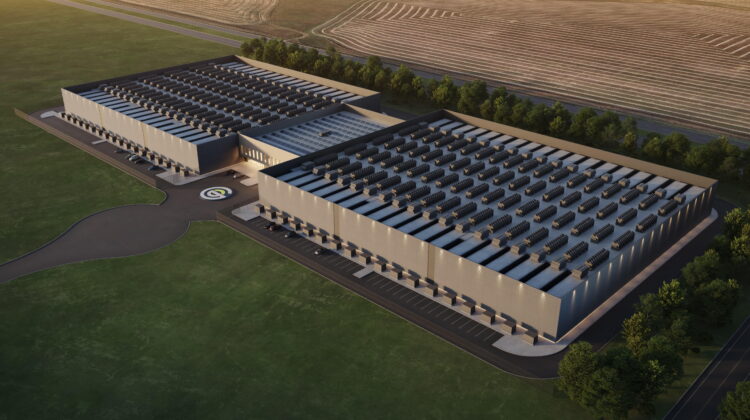
CoreWeave has signed on as the anchor tenant for the first phase of eStruxture’s new CAL-3 facility, a major endorsement of Alberta’s emerging role in Canada’s artificial intelligence infrastructure buildout.
Montreal-headquartered eStruxture Data Centers announced today that CoreWeave, the Nasdaq-listed cloud platform built for AI workloads, will take capacity in Phase 1 of CAL-3, the company’s new flagship facility in the Calgary region. The agreement marks a significant milestone for the 90-megawatt, Tier III-designed data centre in Rocky View County, which has been engineered for the high-density power and cooling demands of modern AI computing.
CAL-3 is scheduled to come online in the second half of 2026 and represents part of eStruxture’s more than $1 billion investment in Alberta digital infrastructure. The company said the facility will combine carrier-neutral, high-density infrastructure with the power and reliability required to deploy GPU clusters at scale, making it suitable for training, inference, and generative AI workloads.
“Calgary has officially arrived as a top technology destination,” said Todd Coleman, Founder, President and CEO of eStruxture. “Our CAL-3 facility was designed to push the boundaries of power density and cooling efficiency, and CoreWeave’s commitment to anchor Phase 1 is a powerful endorsement of eStruxture’s platform. This is eStruxture delivering on its promise to bring the infrastructure Canada’s AI economy needs.”
CoreWeave, which describes itself as “The Essential Cloud for AI,” selected the site for its operational capabilities and Alberta’s growing position as a destination for global digital infrastructure investment. Founded in 2017, the company completed its public listing on Nasdaq under the ticker CRWV in March 2025.
Sachin Jain, Chief Operating Officer of CoreWeave, said the investment reflects Alberta’s proactive approach to fostering AI innovation, adding that the provincial government and Invest Alberta have been “terrific partners every step of the way.”
“That kind of commitment matters when we make long-term AI infrastructure investments,” Jain said. “These facilities serve as anchors for regional economic activity that can compound over time for the communities that host them. We are pleased to partner with eStruxture on CAL-3 and look forward to serving customers across Canada from this facility.”
The announcement comes as access to high-performance computing becomes increasingly central to national competitiveness, with AI developers, cloud providers, enterprises, and governments all seeking secure and scalable compute capacity closer to home.
Brad Parry, President and CEO of Calgary Economic Development and CEO of Opportunity Calgary Investment Fund, said the partnership shows that the Calgary region has the fundamentals global technology companies are looking for: reliable power, room to scale, strong connectivity, and the capacity to build next-generation infrastructure.
“It also expands access to the computing power local companies need to grow and compete globally – supporting more high-quality jobs and strengthening our position in Canada’s AI economy,” Parry said.
For eStruxture, the CoreWeave commitment further cements the company’s role as Canada’s largest data centre platform. The company operates facilities in Montreal, Toronto, Calgary, and Vancouver, serving nearly 1,000 customers across sectors including carriers, cloud providers, AI, GPU-as-a-service, media, financial services, and enterprise customers.
“This project not only reinforces Canada’s data economy,” Coleman said, “it cements Alberta as a critical node in the global AI supply chain.”
The CAL-3 announcement also gives Alberta another high-profile proof point in the race to attract AI infrastructure investment. As demand for compute continues to climb, power availability, land, connectivity, and speed to deployment are becoming defining factors in where the next generation of AI data centres gets built.
For Calgary, landing CoreWeave as CAL-3’s anchor tenant signals that the region is no longer simply pitching itself as a future data centre market. It is now beginning to host the kind of large-scale AI infrastructure that will underpin Canada’s next phase of digital growth.