

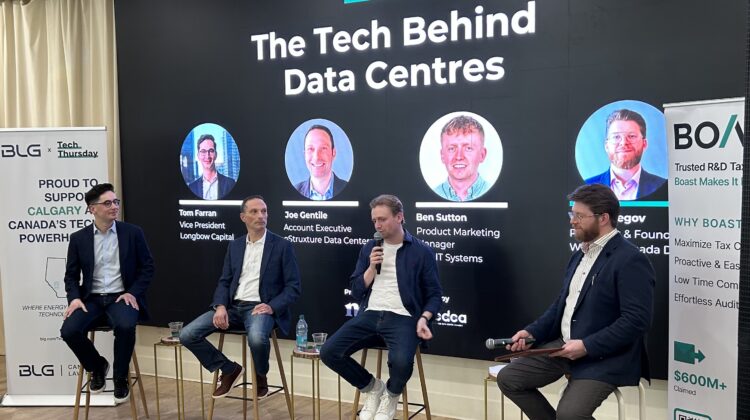
Artificial intelligence is not just increasing demand for data centres—it’s fundamentally reshaping how they are designed, powered, and operated.
That was the central takeaway from a Tech Thursday panel in Calgary featuring Joe Gentile of eStruxture Data Centers, Tom Farran of Longbow Capital, and Ben Sutton of CoolIT Systems. The discussion, moderated by Vlad Oujegov of the Western Canada Data Centre Alliance, explored how the industry’s infrastructure stack is being rebuilt in real time.
At the heart of the transformation is power.
“Historically, you could go to the utility and ask for 20 or 50 megawatts,” said Farran. “You can’t just ask for a gigawatt anymore.”
With grid connections now taking five to seven years in some cases, operators are increasingly adopting a “bring your own power” model—building on-site generation using natural gas or hybrid systems to meet immediate demand . The shift reflects both the scale of AI workloads and the limitations of existing infrastructure.
Cooling is undergoing a similarly dramatic evolution.
Traditional air-based systems are no longer sufficient for modern AI chips, which generate far higher heat densities. As a result, liquid cooling—once limited to high-performance computing—is rapidly becoming standard.
“You can no longer cool these chips with air,” said Sutton, describing a shift toward direct-to-chip liquid systems and full heat capture architectures .
These systems are significantly more efficient. Power usage effectiveness (PUE), a key industry metric, is dropping from roughly 1.6 in legacy facilities to closer to 1.1 in liquid-cooled environments—meaning far more energy is being directed to compute rather than cooling overhead .
At the same time, the scale of development is expanding rapidly. As Oujegov noted, even a single two-gigawatt project would rank among the largest capital investments in Canadian history . Data centres are increasingly being compared not to commercial buildings, but to industrial infrastructure such as power plants.
Demand is also outstripping supply. Gentile explained that new facilities are often pre-leased before completion, as hyperscalers and emerging “neocloud” providers rapidly absorb available capacity.
Layered on top of these technical shifts is a growing focus on data sovereignty. Gentile pointed to increasing concern among governments and enterprises around where data is stored and who ultimately has access to it, particularly in light of foreign jurisdiction risks .
Taken together, these changes signal a broader reset. The data centre is no longer just a place to store and process information—it is becoming a tightly integrated system of power, cooling, and compute, optimized for the demands of AI.
And as that system evolves, so too does the infrastructure that underpins the digital economy.