

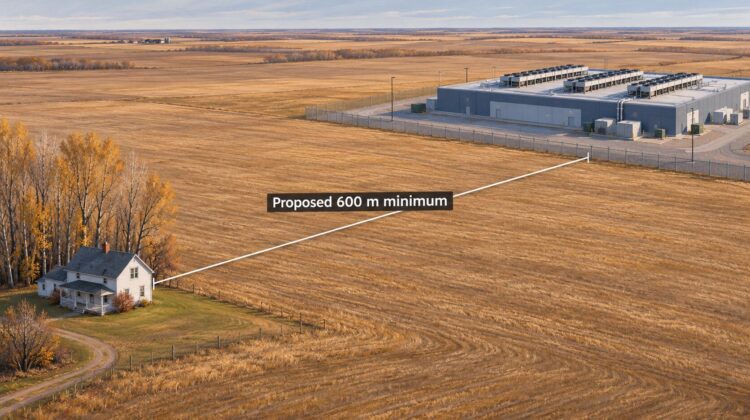
Alberta is proposing that new data centres drawing 10 megawatts or more sit at least 600 metres from the nearest home, measured from the edge of the project site. The province also wants to keep those facilities off irrigated land and its most productive farmland.
Technology and Innovation Minister Nate Glubish introduced Bill 42, the Energy, Environment and Utilities Statutes Amendment Act, 2026, on November 18. The government says the proposal responds to concerns residents raised in a provincial survey and at four town halls in August and September.
Under the province’s proposal, the Alberta Utilities Commission would become the lead provincial regulator for projects at or above 10 MW. Municipalities could ask the commission for a different setback where local plans support it. The province wants to steer developers toward brownfield sites, designated industrial zones and existing power plants.
The proposed farmland protections would cover Class 1 and 2 agricultural land, as well as Class 3 land in municipalities that have neither of the two higher grades. Alberta estimates those categories account for roughly 14 million acres. The proposed restriction on currently irrigated land would apply regardless of grade.
For operators, the province is proposing a standard aimed at bringing cooling water use close to zero. Facilities would have to measure and report their water use and make it possible to recover excess heat for nearby greenhouses, homes or industrial users. Alberta Environment and Protected Areas would continue to handle water licensing and environmental approvals.
The government says projects that already have development permits and are well into construction would fall outside the new rules, according to The Canadian Press. That includes Meta’s $13-billion campus in Sturgeon County, where construction began in July.
Bill 42 passed first reading on November 18. If the legislature passes it, the province and the commission would set the detailed requirements through regulations and commission rules.